

Codex · Character
Sister Vaela Norn
- Location
- Brindlehook
- Posing as
- Pilgrim healer
- Allegiance (hidden from players)
- Veiled Concord
As she stood on 25 Emberwane, 742
Define whatever kinds of things your world actually contains, from bloodlines to wards to debts to seasons, and Dexes keeps every one of them straight on your map, in your prose, and across your campaign's whole history.
Free, as soon as we have room for you. We are admitting new worlds in batches while we scale, so you may join a waiting list. Your place is saved when you sign in, and signing in again any time checks it for you.
 Vaela Norn
Sister Vaela Norn
Drag the date. The map and the Codex resolve to that day. Illustrated with the demo world you can open after signing in.
It was originally being built for personal use and is still being refined. Everything on this page works today, and it is evolving week to week.
A document tells you what was true the last time you edited it. A long campaign has no single now. It has a chronology, and holding that chronology in your head is half the work of running the game.
varnwood_final_v3.png| Vaela Norn | Pilgrim healer | Varn Hollow? |
| Elian Voss | Surveyor | Missing since? |
"Where was Vaela when the party went into the vault?"
30 Emberwane, 742Write it down once. It stays correct everywhere, on every date.
A wiki stores text about things. Dexes stores the things themselves, and your map, the tree, your prose and the timeline are all views onto them.
Not a fixed set of templates. Define your own object types with their own fields, relationships, inventories, memberships and nesting, then lay each one out the way you want to read it.
The keep is not invisible. The ward makes travelers decide they have no reason to approach it, forget directions, and reinterpret maps.
Magistrate Iona Pell hires the party to recover the missing surveyor or his records.
The buried intelligence beneath the Titan Steps, and the reason the Deep Well calls to sleepers.
One object is a pin on the map, a node in the tree, an endpoint in the relationship graph and a link in your prose. Not four records that point at each other. One object, seen from four places, on whatever date you pick.
 Lady Aveline Sarrow
 The Vessel ProjectAvelineVessel ProjectVaela
 Liora Vey
Swipe across: the same object in all four.
Visibility is set field by field, so one character carries what the table knows and what only you do. There is no second copy to keep in step. Player View shows you the world as a player gets it, before they do.
Map, Codex, Timeline and Tome are views onto the same world. Pick a day in any of them and the others follow.
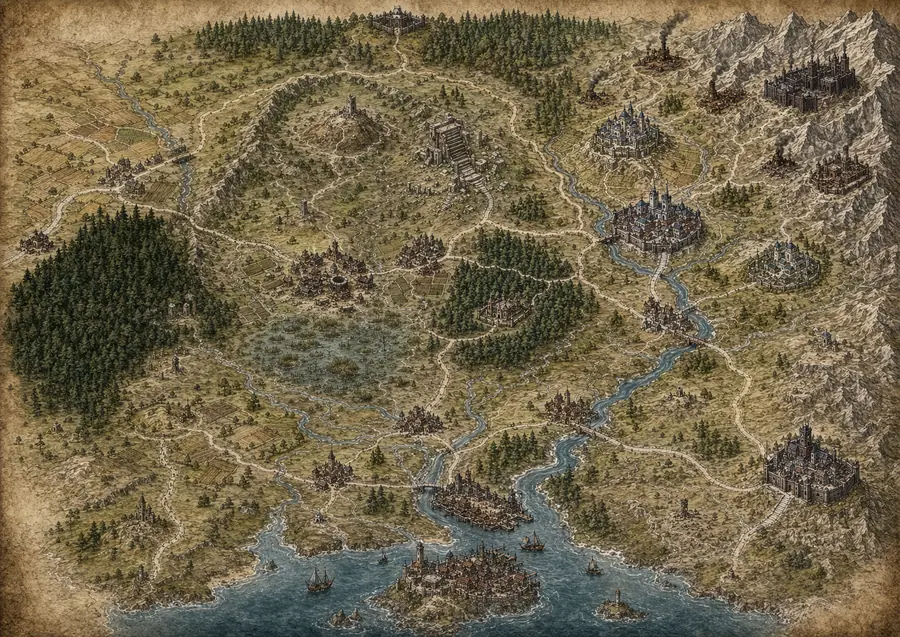
Upload the map you already love, then add what a static image cannot hold: pins, nation and biome regions, roads and rivers, curved labels, layers, and movement paths that follow the date.
Every person, place, faction and object, plus any type you define. Nest them, relate them, and date every change.
 Veiled Concord Sister Vaela Norn
 Gray Veil of Borrowed Faces Lady Aveline Sarrow
 Basin Survey Fellowship
 Lantern Roadwardens
Run a real calendar with leap years, your own months and weeks, or plain milestones for looser stories. Every object keeps its own history.
Write chapters in a live-preview Markdown editor. Type two square brackets to link a person, place or page, and every object lists where it is mentioned.
Memberships, holdings and allegiances drawn as a graph that follows the selected date.
Births, deaths, joinings, losses and field changes for any one object, in order.
Markdown notes for half-formed plans, each pointing at the objects it concerns.
One library for portraits, badges and maps, with stock art to start from and a record of where each image is used.
Invite by email. Players read, co-GMs build, and a single object can be shown to one person alone.
Your world leaves when you do: a standard archive with its images, and it imports again the same way.
Every map and portrait on this page comes from the demo world. It is waiting inside, yours to edit for 30 days or to keep.
Get started for freeNothing here is hardcoded to a game system. Every world starts as a general storytelling world. Switch one to tabletop and the table tools appear in that world alone: dice, initiative, encounters, clocks, fog of war, and a player view.
Codex, map, timeline and prose, and nothing you did not ask for. If you are writing a novel, you will never see a dice roller.
A dice roller with saved rolls and tables, an initiative order your players watch live, prepared encounters, progress clocks, fog you paint day by day, and a preview of what each player sees. Your next project does not inherit any of it.
Your world is yours. Sharing it with your players does not mean publishing it to the internet, and bringing your table along is never a budget decision.
Player seats are free on the free tier too, and are never counted against it. Only co-GM editor seats are metered, because those are people building the world alongside you.
No public gallery, no ads on your campaign. A world is visible to you and to the people you invite by email, and to nobody else.
Visible to Players is set field by field, so a single character carries what your table knows and what only you do. There is no second copy to keep in step.
There is a free tier, and it is a real one. The paid tiers are support tiers on Patreon, for worlds that outgrow it and for co-GM seats.
Dexes is still in development. It was built for private use first and is still being refined, and what it costs to host other people's worlds is not known yet. So the paid tiers run through Patreon for now, and these prices and limits are our best guess today. They may change as we learn what the hosting really costs.
Limits today. A limit only ever stops new things being added: nothing you have made is hidden or removed.
| What each tier includes | Free$0 | Copper$5 a month | Silver$10 a month | Gold$25 a month |
|---|---|---|---|---|
| Image storage | 250 MB | 1 GB | 5 GB | 20 GB |
| Stories | 3 | 3 | 10 | Unlimited |
| Maps per story | 5 | 5 | 25 | Unlimited |
| Codex objects per story | 100 | 100 | 1,000 | Unlimited |
| Custom types per story | 5 | 5 | 10 | Unlimited |
| Tomes per story | 1 | 1 | 10 | Unlimited |
| Timeline days per story | 100 | 100 | 1,000 | Unlimited |
| Player seats | Free | Free | Free | Free |
| Co-GM seats per story | None | None | 2 | Unlimited |
| After 12 months without signing in | Account may be deleted | Kept | Kept | Kept |
Swipe the table sideways to compare the tiers.
To support Dexes, pledge on Patreon and connect your Patreon account from the Support Tier section of your profile. Your tier updates by itself, and if a pledge ends there is a grace period before anything changes.
That is an evening, not a project. Everything else moves across the way it comes up in play.
No new password to keep. If we are at capacity, your place in line is saved under your account.
A complete campaign with a map, a populated Codex, a timeline and written chapters. It is yours to edit for 30 days, or to keep.
Upload the image you already use and pin the places your table keeps going back to.
After each session, write down what changed and when. A guided tour points at each control as you reach it.
Still unsure? The help pages cover every screen in detail.
No, and you should not try. Start with the map you already have and the dozen people, places and factions that come up every session. That is an evening, not a project. Everything else moves across the way it comes up in play: the moment you need an NPC's history, you write it once, in the place it belongs, and it is there from then on.
Worlds built all at once tend to be abandoned all at once. The ones that last get built a session at a time.
You do not have to start from a blank page. Dexes offers you a fully built demo world when you arrive, with maps, a populated codex, a timeline and written chapters, so you can see the shape of the thing before deciding how to build your own. It is a real, editable sandbox: change anything, break anything. Keep it and it becomes your world, or load it any time from the bottom of your story list.
There is also a guided tour built into the app that walks you through each surface as you reach it, so you are never staring at a toolbar wondering what it does.
Yes, always, and you can bring it back in. Export a world, its full contents and its images, whenever you like. It is a standard archive you can open with any unzip tool: a plain copy of your own data, not a proprietary bundle you need Dexes to read. Import works the same way, so moving a world between accounts or restoring an old one is your call, not a support request.
Nobody should build two years of history somewhere they cannot leave.
There is a free tier and it is a real one: private worlds, your own map art, custom types, the full timeline, and your whole table along for free. It is not a trial that expires.
It has the room to build a world and run a game in. Worlds that keep growing, and long campaigns do, eventually want more space than the free tier holds, and that is what the support tiers on Patreon are for, alongside co-GM editor seats.
No, and they are never counted against your tier. Player seats are free on every tier including the free one. Only co-GM editor seats are metered. A player who never logs in costs you nothing at all.
No. Every world is a general storytelling world until you switch it to tabletop mode, and the table tools only appear in the world you switched. Codex, map, timeline and prose work the same either way.

Sign in with Google, explore a fully built demo world, and start connecting the maps, characters, histories and chapters of your own.
Build a world that remembers.